Antiquity


Ancient Egypt, Ancient Greece, Imperial Roman Period, Ancient Middle East.


6 subcategories
Ancient Egypt

ANCIENT EGYPT

Ancient Greece

ANCIENT GREECE

Ancient Israel

ANCIENT ISRAEL

Ancient Jordan

ANCIENT JORDAN

Ancient Middle East

ANCIENT MIDDLE EAST

Imperial Roman Period

IMPERIAL ROMAN PERIOD

7,457 photos
Swimmer, in braided dress, holding a box. Head and feet were added on. Phoenician, Persian period.
Bone, H 17,8 cm  L: 4 cm
MN 1355, N 8312
#30010115

Swimmer, in braided dress, holding a box. Head and feet were added on. Phoenicia...

Two dolls, both from South-West Iran, Parthian period.
From Susa, Iran.
Bone, left H: 9,5 xm L: 2,9 cm, right H: 14 cm, 5,5 cm
Sb 11137, Sb 3830
#30010116

Two dolls, both from South-West Iran, Parthian period. From Susa, Iran. Bone,...

Three nude women, all from South-West Iran, Parthian
period, from Susa. Bone.
1.Nude, holding breasts,with high hairstyle. H: 8,5 cm,
Sb 3702
2. Nude,holding breasts, H: 8,5 cm, L: 2,2, Sb 3692
3. Nude, without arms, H: 10,5 cm L: 2,5 cm  Sb 3812
#30010117

Three nude women, all from South-West Iran, Parthian period, from Susa. Bone....

Handle with Mythological Egyptian decoration. The child Harpocrates sitting on a lotus. Phoenician, Roman period.
Bone, H: 10,5 cm
AO 2487
#30010119

Handle with Mythological Egyptian decoration. The child Harpocrates sitting on a...

Handle or case in form of a sphinx, with an Egyptian "klaft" headdress, 1st - 2nd CE.
Bone, H: 6,2 cm
AM 1512
#30010120

Handle or case in form of a sphinx, with an Egyptian "klaft" headdress, 1st - 2n...

Clapper, 6th or 7th CE, three diffrent pieces put topgether.
Bone, handle H: 17 cm; first clapper H: 4,3 cm, second
clapper H: 4,2 cm.
E 13512, E 21275, E 21272
#30010123

Clapper, 6th or 7th CE, three diffrent pieces put topgether. Bone, handle H: 17...

Diptych with the Muses.
Ivory, H: 29 cm
SMD 46
#30010124

Diptych with the Muses. Ivory, H: 29 cm SMD 46

A senator presiding over the games in the circus, first half
5th. Probably from Gaul.
Ivory, H: 18 cm
OA 9062
#30010125

A senator presiding over the games in the circus, first half 5th. Probably from...

Statuette of Tueris, Middle Kingdom, 2040-1785 BCE.
Hippopotamus ivory, H: 13 cm
N 3619, E323
#30010139

Statuette of Tueris, Middle Kingdom, 2040-1785 BCE. Hippopotamus ivory, H: 13 c...

Handle of a mirror, Egypt, New Kingdom, 2nd Mill.BCE.
Ivory,Hippopotamus, H:15,5 cm
N 1776, E 306
#30010140

Handle of a mirror, Egypt, New Kingdom, 2nd Mill.BCE. Ivory,Hippopotamus, H:15,...

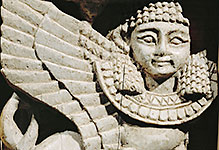
Ivory plaque depicting a winged sphinx, Phoenician, found at Fort Shalmaneser, Nimrud (ancient Kalhu), northern Iraq, 9th-8th century BC. Fort Shalmaneser consisted of a palace, storerooms and arsenal for the Assyrian army. This openwork ivory plaque may originally have been part of a piece of furniture which came to Nimrud, the Assyrian capital, as part of tribute or booty. When Nimrud was plundered at the end of the seventh century BC objects such as furniture were broken up for their inlaid precious stones and metals. The sphinx shows clear Egyptian influence since he wears the Upper and Lower crown of Egypt and hanging from his chest is an apron with a projecting uraeus (rearing cobra) worn by Egyptian pharaohs. The style shows that the ivory was probably carved by a Phoenician craftsman on the coast of the Levant. It is similar to the falcon-headed sphinxes, which wear the double crown and uraeus, on a bronze bowl also from Nimrud.
ANE, 134322
#30010141

Ivory plaque depicting a winged sphinx, Phoenician, found at Fort Shalmaneser, N...

Side part of a diptych's tablet in five parts: Cure of the woman with the issue of blood, cure of the paralysed, cure of the posessed
Around 400; Rome
Ivory; 19,70cm x 7,90cm
OA 7876, OA 7877, OA 7878
#30010150

Side part of a diptych's tablet in five parts: Cure of the woman with the issue...