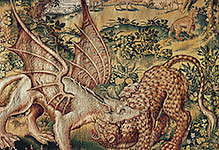
Mytological Animals


Mythological animals.


683 photos
Jason and the dragon.Augsburg, end 16th.               
Bronze sculpture, H:36 cm                              
Bronzes de la Couronne, 224
#300107 2

Jason and the dragon.Augsburg, end 16th. Bronze sculpture, H:36 c...

Dragon-pendant worn with the Order of the Golden Fleece,
a ruby from Brittany of 107,88 carat, from the collection of 
Marguerite de Foix, Duchess of Brittany, inherited by her daughter Anne de Bretagne, queen of France 1492-1514.
Diamonds of the Crown.
#30010749

Dragon-pendant worn with the Order of the Golden Fleece, a ruby from Brittany o...

Gold-glass medallion showing Heracles and a husband and wife, and a small image of Herakles, 4th. The man wears a tunic with a red stripe and she wears a gemstone nacklace with pendant pearls. The inscription to "Orfitus and Constantia" could point to Memmius Vitruvius Orfitus, a pagan aristocrat and prefect of Rome in the 4th century. Herakles wears the  skin of the Nemean lion and carries his club and the apples of the Hesperides, which were his wedding present to Jupiter and Juno, suggesting that the medallion was a wedding gift.    M&ME, 1863,7-27,3
#300108 2

Gold-glass medallion showing Heracles and a husband and wife, and a small image...

Brass hanging lamp with a griffin handle, Early Byzantine, 5th-6th century. The lamp is boat-shaped with holes for oil and wick. The curved neck of a griffin emerges from a calyx to form a handle. A dove sits between the griffin's ears, above a Christogram.Hanging chains may be original to the lamp, but it also has a bayonet fitting on the base for a stand. Found at Herculaneum,Italy.     M&ME,1897,8-20,1
#300108 3

Brass hanging lamp with a griffin handle, Early Byzantine, 5th-6th century. The...

The Borradaile oliphant,Byzantine, 11th. A sounding horn carved with rows of interlocking medallions. An animal is displayed in each circle (winged griffins, heraldic eagles, lions, peacocks and snakes). Motifs are part Western, (the
continuous scroll pattern of interlaced bands), part Arab influence.                                             M&ME, 1923,12-5,3
#30010817

The Borradaile oliphant,Byzantine, 11th. A sounding horn carved with rows of int...

The Borradaile oliphant,Byzantine, 11th. A sounding horn carved with rows of interlocking medallions. An animal is displayed in each circle (winged griffins, heraldic eagles, lions, peacocks and snakes). Motifs are part Western, (the
continuous scroll pattern of interlaced bands), part Arab influence. Reverse side of  30-01-08/17                                            M&ME, 1923,12-5,3
#30010818

The Borradaile oliphant,Byzantine, 11th. A sounding horn carved with rows of int...

Icon of Saint George, Byzantine,from the village of Pskov, Russia. The panel was used as the shutter of a barn window. Overpainted several times, the 14th century icon was finally uncovered by museum custodians. Saint George on a black horse is rare and accounts for the icon's popular name of "Black George".                                             M&ME 1986,6-3,1
#30010819

Icon of Saint George, Byzantine,from the village of Pskov, Russia. The panel was...

0310000141
Stove-tile with the arms of James I, c1603-c1625. Earthenware stove-tile in the form of a panel with the lion and unicorn, and the royal Stuart coat-of-arms and the 'IR' cypher ('Iacobus Rex') for King James VI of Scotland and I of England. The incorporation of the Tudor rose and the Scottish thistle at the base symbolises the union of the two crowns. The coat of arms reflected loyalty to the crown. Wood-burning stoves were often made up from elaborately decorated tiles which were being produced in England in small numbers in the sixteenth and seventeenth centuries. By the end of the sixteenth century the severe shortage in the south of England of wood for burning meant that coal, from Newcastle, was the primary source of heating fuel. Coal was not suitable for burning in closed stoves.
M&ME, 1981,3-6,1
#30010835

0310000141 Stove-tile with the arms of James I, c1603-c1625. Earthenware stove-...

Silver pendant, Slav (Kiev type), 12th century. This silver temporal pendant or earring is one of a pair. It would have been worn in the region of the temples, suspended from a crown or head-dress. The pendant is decorated with an interlaced, mythical animal and geometric designs on a black, nielloed ground. The animal may be a dynastic symbol. Silver pendants of this type are later versions of gold examples and would have been worn as female court regalia at ceremonial occasions in the princely court of Kiev, the capital of the early state of Rus'. The pendant was found in 1906, buried in a metal casket in Trekhsvyatytelska Street (Street of the Three Saints), opposite the gates of the Mikhailovsky Golden Dome Monastery in Kiev, Ukraine. The hoard was probably buried at the time of the Tartar invasions and sack of Kiev around 1240.
M&ME, 1907,5-20,13
#30010870

Silver pendant, Slav (Kiev type), 12th century. This silver temporal pendant or...

Portable mosaic: Saint George defeating the dragon
First half of the 14th century; Constantinople
OA 3110
#30010942

Portable mosaic: Saint George defeating the dragon First half of the 14th centu...

The legend of Sigurd (Siegfried) from the Edda (collection of norse mythological poems):
Sigurd slaying the dragon (Fafnir).
Wood panel from a church in Setesdal, Norway; 12th century
#30011041

The legend of Sigurd (Siegfried) from the Edda (collection of norse mythological...

Lombard marble relief with dragons from sarcophagus of Abbese Theodata, from monastery of Santa Maria della Pusterola, Pavia. Around 735 CE
see also 30-01-01/56-57
#30011044

Lombard marble relief with dragons from sarcophagus of Abbese Theodata, from mon...